
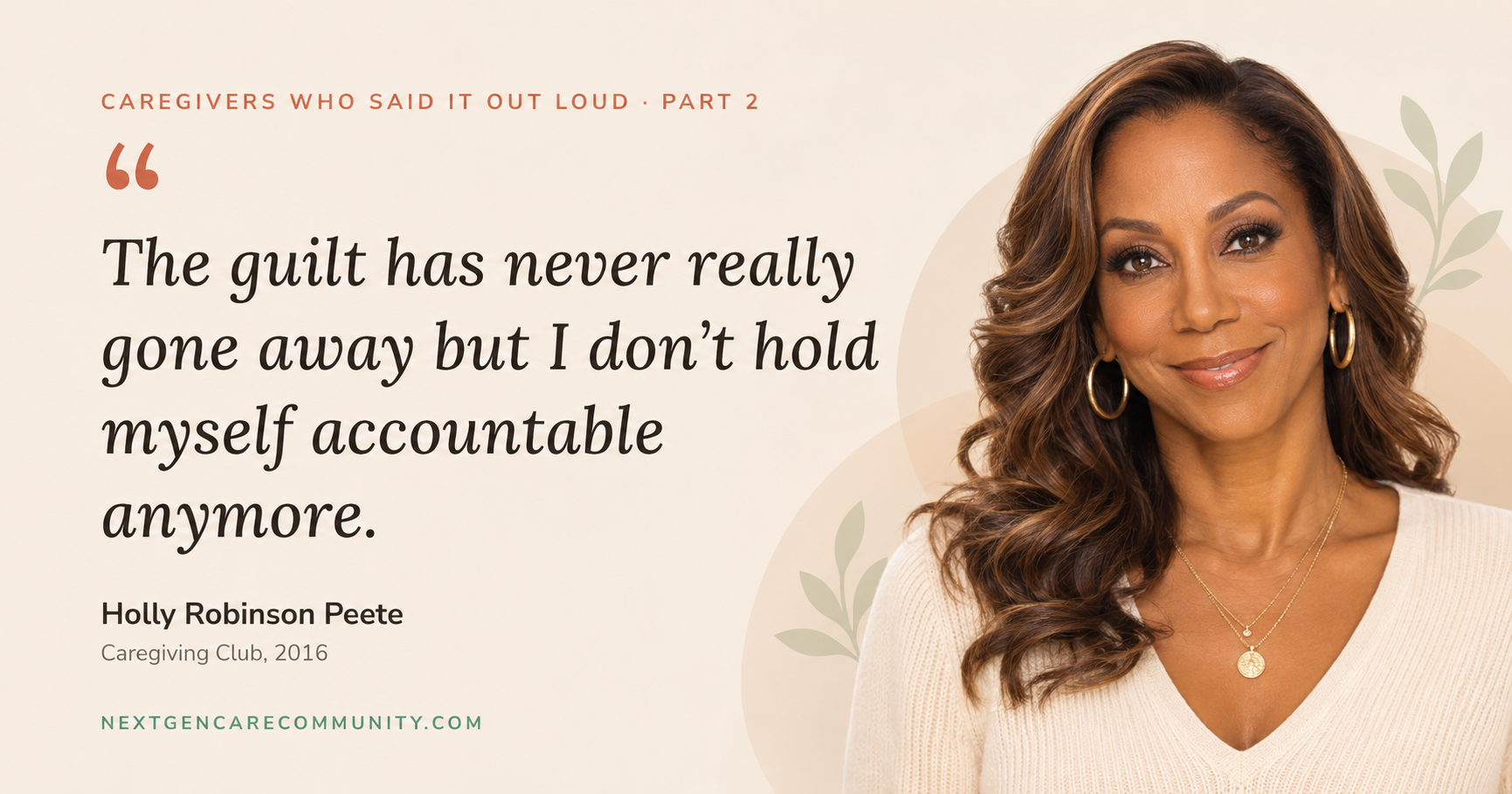
Most celebrity caregiving stories have a tidy arc. Hard diagnosis, brave fight, lesson learned, foundation launched. Holly Robinson Peete’s story has the foundation part, but she keeps refusing to make the rest of it tidy. Years after her father died, she was still saying this:
“The guilt has never really gone away but I don’t hold myself accountable anymore.” (Caregiving Club, 2016)
I read that and thought, finally. Someone who isn’t pretending the guilt evaporates once you’ve done your best.
If you’ve ever made a care decision for a parent and then replayed it for years, this one’s for you.
Her dad, then her son
Her father, Matthew Robinson, was the first actor to play Gordon on Sesame Street and later worked as a writer and producer. He was diagnosed with Parkinson’s at 45, while Holly was a student at Sarah Lawrence College. Her parents were divorced, so she and her brother took on his care. She has said she briefly thought about leaving college to care for him full time. An AARP video describes her becoming his primary caregiver at 19.
“My first reaction to my dad’s diagnosis was ‘what is Parkinson’s’?” she said. There wasn’t much information then, and she learned by trial and error.
Then her life got bigger. She became a TV star on 21 Jump Street, married former NFL quarterback Rodney Peete in 1995, and moved to Los Angeles, while her father stayed in New York. She became a long-distance caregiver. In 1997 she had twins, and when her son RJ was 3, he was diagnosed with autism.
So for a few years she was doing both at once: managing a parent’s progressing disease from across the country and fighting for a young child’s diagnosis and therapy. “I was in what they call the sandwich generation,” she told an audience in 2017.
https://www.youtube.com/watch?v=_wAw9a9CYkM
The day she calls the worst of her life
Eventually her father needed round-the-clock care in a facility. She has never softened how that felt. “The day we moved my dad into the facility was the worst day of my life,” she said. “To this day I have regrets about the decision, but there were not a lot of choices.”
He died in 2002.
That sentence, “there were not a lot of choices,” is the one I’d underline. So many of us are making care decisions where none of the options are good. Not “right versus wrong,” just “hard versus harder.” And then we judge ourselves later as if we’d had a menu of perfect choices and picked the wrong one.
What her story says to the rest of us
Guilt isn’t proof you made the wrong call. Holly still has regrets about the facility, and she also says there weren’t many choices. Both are true at once. Guilt often shows up because you love someone and couldn’t give them everything. That’s grief wearing a different coat. It doesn’t automatically mean you failed them.
The guilt doesn’t have to leave for it to stop running you. Notice what she actually said: the guilt never went away, but she stopped holding herself accountable. That’s a much more realistic goal than “let it go.” She also described what she did with it: “At some point, you take your guilt and you move on and I did that by paying it forward.” For her that meant the HollyRod Foundation, which she and Rodney started in 1997 in honor of her father. For the rest of us, paying it forward might be much smaller. Telling a friend what you wish you’d known. Showing up for someone who’s six months behind you.
Trust your gut, especially about your kids. When RJ was diagnosed, she said, “my life just stopped right there in that doctor’s office.” She also said her husband first thought RJ just needed more discipline, and “I knew it wasn’t about that at all.” Years later she still said, “I still kick myself for not getting him that therapy for that one year.” If you’re the parent who notices something is off, with a child or a parent, that noticing counts. You don’t need everyone to agree before you ask a doctor.
It’s usually the daughters. She said that in her experience it’s “mostly the daughters” who “end up doing the heavy lifting of caregiving.” If you’re a daughter carrying most of the load while a brother calls in once a week, you’re not imagining it, and it’s okay to say it out loud to your family.
Two kinds of caregiving that pull in opposite directions
There’s something specific about her situation that I don’t see talked about enough. Caring for a parent with a progressive illness is about slowing a loss and protecting dignity. Caring for a young child with a new diagnosis is about fighting for growth and getting services fast. Those take different kinds of energy, and doing them at the same time can feel like being pulled in two directions emotionally, not just on the calendar.
Her line about RJ shows the second kind: “No one is ever going to tell me what my kid will not be.” That’s fight energy. Meanwhile, the facility decision for her dad called for acceptance. If you’re living both at once and feel emotionally whiplashed, that’s why.
If you’re facing the facility decision
I’m not a doctor or a care planner, and every family’s situation is different. But here are a few things that can help you make the decision with clearer eyes:
- Write down what’s actually happening day to day for a week or two: falls, nights, missed medications, what you’re giving up, and how your own health is holding up.
- Ask your parent’s doctor what level of care they’d recommend, or talk with a geriatric care manager. The Aging Life Care Association has a directory.
- Visit more than one place, and go back at a different time of day than your tour.
- Bring your siblings in early, before it’s a crisis. (The Maria Shriver post in this series has a simple way to start that conversation.)
- Name the guilt out loud to someone you trust, so it doesn’t quietly make the decision for you.
None of this makes it painless. Holly’s story is proof that even a decision made with love can hurt for years. But taking these steps means that when you look back, you’ll know you decided with real information, not just exhaustion. That’s something you can live with.
Share yours
This is part two of a series about caregivers who said the hard parts out loud. (Part one was Maria Shriver.) If you’ve had to make a decision like this and would be willing to share what it was like, I’d love to hear from you. Email me at alicia@nextgencarecommunity.com.
This post is based on Holly Robinson Peete’s public interviews, linked below. She isn’t affiliated with NextGen Care Community. I’m sharing my own experience and research, not medical, legal or financial advice.
Sources
- Holly Robinson Peete’s Most Challenging Role: Sandwich Generation Caregiver (Next Avenue, Sherri Snelling, Mar 27, 2013)
- Holly Robinson Peete Shines as Caregiver Advocate (Caregiving Club, Sherri Snelling, Nov 14, 2016)
- Holly Robinson Peete on ‘the gift of caregiving’ (Minnesota Spokesman-Recorder, Vickie Evans-Nash, May 31, 2017)
- Holly Robinson Peete’s ‘Hard Road’ Caring For Dad (AARP on YouTube, Nov 18, 2016)
- Aging Life Care Association: care manager directory