
When Emma Heming Willis talks about the day her husband, Bruce Willis, was diagnosed with frontotemporal dementia, she doesn’t describe a plan. She describes walking out of the doctor’s office empty-handed:
“I walked out with nothing, no hope, no direction, no road map, nothing.” (CBS News, 2025)
If you’ve ever sat in a hospital parking lot holding a discharge printout and a diagnosis you can barely pronounce, you know that feeling. You’re suddenly in charge of something enormous and nobody hands you the instructions.
I’m including Emma in this series even though she’s caring for a spouse, not a parent. She’s doing it while raising two young daughters, and the squeeze she describes, between what the person with dementia needs and what the kids need, is the same one a lot of us live with when it’s Mom or Dad.
The part she didn’t know she was allowed to do
Bruce stepped back from acting in 2022, and in early 2023 the family shared his FTD diagnosis. Emma has said the early signs were hard to pin down. In her CBS interview she described communication breaking down and routines that no longer lined up, changes that were subtle but enough to feel that something was off.
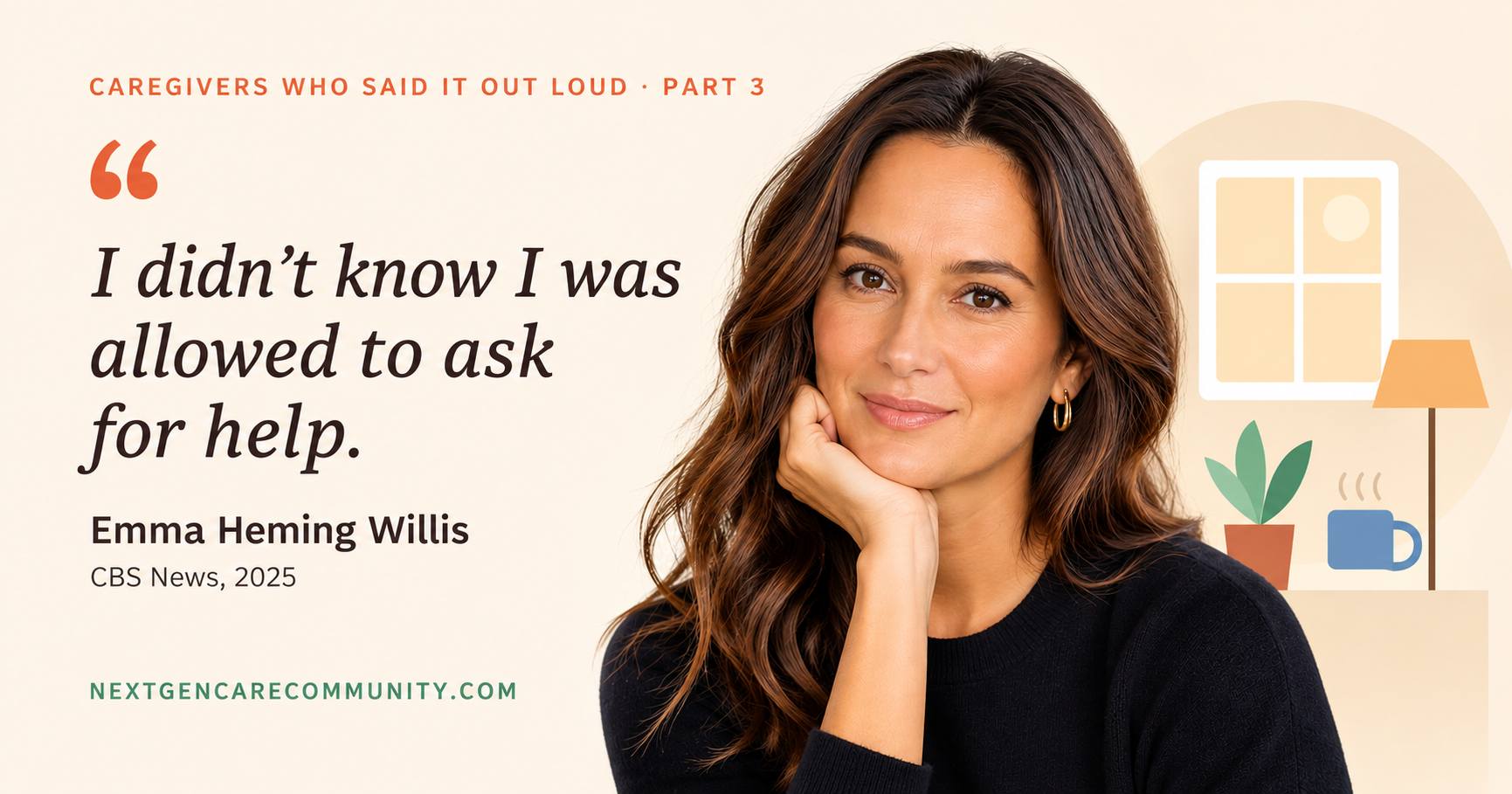
Then came the line that’s on the quote card for this post:
“I didn’t know I was allowed to ask for help.” (CBS News, 2025)
She says she’d always been very self-sufficient. On the BrainStorm podcast, she explained what was underneath that: “bringing in help for me felt like I was failing my husband.”
What changed her mind was a doctor. She says one of Bruce’s neurologists told her she didn’t want to become a statistic, “because sometimes caregivers will pass before their loved one.” Her takeaway was blunt: “You need help. You cannot do this by yourself.” She told CBS the warning floored her, and that it was the wake-up call she needed.
I think a lot of us carry some version of “a good daughter would be able to handle this.” Emma’s story flips that around. She came to see it this way: “in order to take the best care of Bruce, like I needed to also take the best care of myself.” Getting help wasn’t the opposite of caring for him. It was how she kept being able to.
“My wifi was buffering”
This is my favorite thing she said, because it’s so exactly right. Talking about how a caregiver’s stress spreads through a home, she put it this way: “your family, your person living with dementia, they are feeding off your wifi. And my wifi was buffering.”
Anyone who has snapped at their kids after a rough call with the assisted living facility knows what she means. The kids pick up on it. Your partner picks up on it. Your parent, even with memory loss, often picks up on it. That isn’t a reason to pile more guilt on yourself. It’s a reason to count your own rest as part of the care plan instead of something you’ll get to once things calm down. (They don’t calm down. You have to make the room.)
The decision people judged
Emma is honest that the disease changed her daughters’ childhood. Their home had been arranged around Bruce’s needs. “They couldn’t have play dates, they couldn’t have sleepovers,” she said, and she realized “they were not having a normal childhood.”
So the family set Bruce up in a separate home close by, built around his care, with the girls’ home built around theirs. CBS reported that the decision drew criticism online. She stands by it. “It was the right choice for us,” she said on BrainStorm, and she told CBS, “each caregiving journey is our own, each care plan is their own.”
I want to underline that, because most of us will make a care decision someday that somebody else has an opinion about. A sibling, a neighbor, a church friend, a stranger in a Facebook group. The people judging don’t live in your house, and they don’t see what a normal Tuesday looks like for your family. You’re allowed to choose what works for the people actually living it.
What she tells her kids
On talking to children, she said “honesty is really the best policy,” and that “kids are so much more resilient than we give them credit for.” But she doesn’t leave it there, which is what I appreciate most. When people reassure her that her girls will be fine, she pushes back: “I don’t know how a child is going to bounce back from watching their father lose pieces of himself.”
Both things are true for her at once. Kids can handle more truth than we expect, and it can still cost them something. If you’re working out how to talk with your own kids about a grandparent’s changes, I wrote about that in What Do I Tell the Kids?
Grieving someone who’s still here
Emma talks about ambiguous loss, a term she credits to Dr. Pauline Boss. In her words, it “means that your person is physically present, but psychologically not.” You’re grieving someone who is still sitting at the table.
If you’re caring for a parent with dementia, this might be the most useful idea in this whole post. It explains why you can feel grief and guilt and even anger on a random Tuesday when nothing “happened.” Something did happen. You lost a little more of the person you knew, and there’s no funeral or casserole for that.
She also refuses to make any of it pretty: “I’m not going to sit here and paint some beautiful, like, toxic positivity story.” Same, Emma.
If you need help and don’t know how to ask
I’m not a doctor or a social worker, so think of this as a starting point, not a care plan. Here’s something you could do this week:
- Make a list of specific things someone else could take off your plate. Rides, a meal, picking up prescriptions, two hours with your parent so you can sleep.
- Ask one specific person for one specific thing. “Can you take Dad to his Thursday appointment?” gets a yes far more often than “let me know if you need anything.” (There’s more on this in our earlier post on asking for help.)
- Call the Eldercare Locator at 1-800-677-1116 to find your local Area Agency on Aging, and ask what support exists near you.
- If dementia is part of the picture, the Alzheimer’s Association helpline is open 24/7 at 800-272-3900. For FTD specifically, the AFTD HelpLine is 1-866-507-7222, weekdays 9 a.m. to 5 p.m. Eastern.
- Tell your kids the truth at a level they can handle, and let them help in small ways if they want to.
Asking won’t feel natural at first, especially if you’re the one everyone else leans on. But even one afternoon of real help can be the difference between running on fumes and having something left for your kids, your parent and yourself. Emma needed a neurologist to give her permission. Consider this yours.
Share yours
This is part three of a series about caregivers who said the hard parts out loud. (Part one was Maria Shriver, and part two was Holly Robinson Peete.) If you’ve struggled to ask for help, or found a way that finally worked, I’d love to hear about it. Email me at alicia@nextgencarecommunity.com.
This post is based on Emma Heming Willis’s public interviews, linked below. She isn’t affiliated with NextGen Care Community. I’m sharing my own experience and research, not medical, legal or financial advice.
Sources
- Emma Heming Willis explains why Bruce Willis has separate home as part of dementia care (CBS News, Analisa Novak, Sep 10, 2025)
- Emma Heming Willis opens up about caregiving Bruce Willis (CBS Mornings on YouTube, Sep 10, 2025)
- BrainStorm podcast: Emma Heming Willis on The Unexpected Journey (UsAgainstAlzheimer’s, Sep 25, 2025)
- AFTD HelpLine: 1-866-507-7222
- Eldercare Locator: 1-800-677-111