
What Maria Shriver Gets Right About the Sandwich Generation
There’s something Maria Shriver said in a 2020 AARP interview that I keep coming back to. She was talking about the years she spent caring for her parents while raising her own kids, and she put it like this:
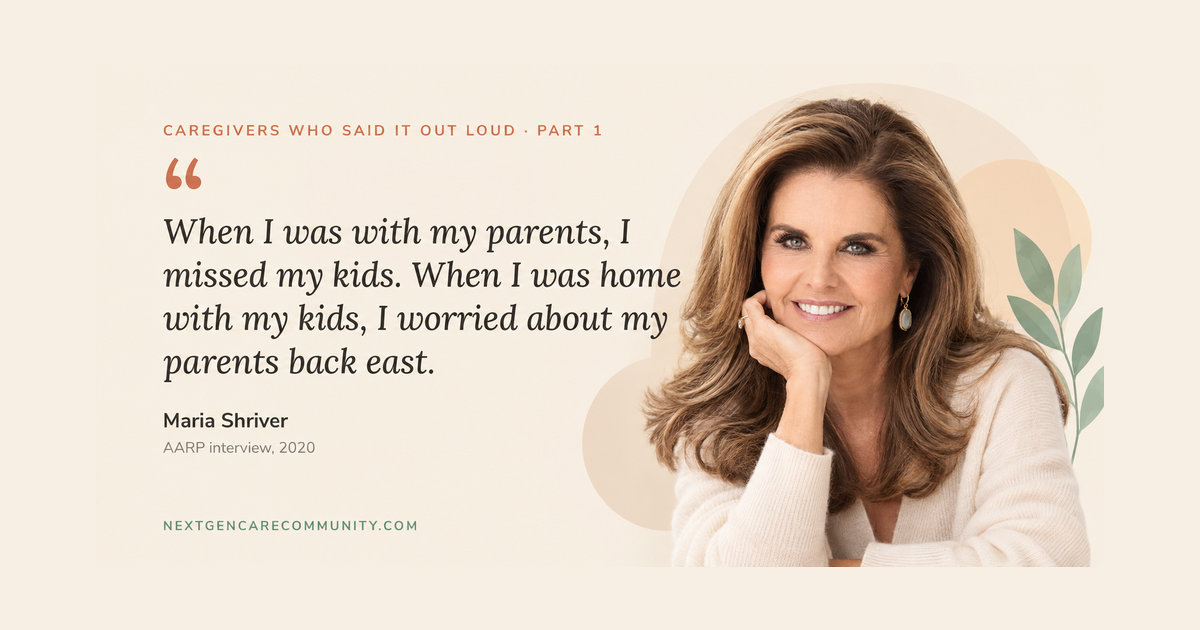
“When I was with my parents, I missed my kids. When I was home with my kids, I worried about my parents back east.”
That’s the sandwich generation in two sentences. You’re never all the way in the room you’re in. Some part of you is always somewhere else, half listening for the phone, doing math about flights and school pickups and who’s covering Thursday.
I’m starting this series with her for that reason. Not because she’s famous, and not because her life looks like most of ours (it doesn’t, and I’ll get to that). I’m starting with her because she said the quiet part out loud, on the record, and then kept saying it.
Caregiving is something that is deeply human and is a shared experience no matter what your last name is or where you fall in the tax bracket. No matter who you are, we can all relate to the feelings of guilt, overwhelm, frustration and exhaustion.
What happened in her family
Her father, Sargent Shriver, was diagnosed with Alzheimer’s in 2003. Her mother, Eunice Kennedy Shriver, also needed more and more care, and for a stretch the two of them needed it at the same time. Her mother died in 2009.
She didn’t sugarcoat what that was like. In the 2010 report she led on women and Alzheimer’s, she opened with “I’m Maria Shriver, and I’m a child of Alzheimer’s,” and wrote that her father no longer knew she was his daughter or remembered her name. She described visiting him: “I say, ‘Hello, Daddy.’ He says, ‘God bless you!'” And she named the feeling a lot of us know and rarely admit: “No matter who you are, how old you are, what you’ve accomplished… you feel powerless.”
She also didn’t do it alone, and she’s clear about that. She and her four brothers set up a weekly family call, first about their mom’s health and later about their dad’s, and divided the work. Two of her brothers lived in Washington, D.C., near their parents, and handled a lot of the in-person care. “They were both in need of care and attention at the same time, and my brothers stepped up,” she told AARP.
So she was, in a real sense, a long-distance caregiver who was also raising four kids in California. If you’re the one who lives far away, you probably recognize that particular kind of guilt.
Three things her story says to the rest of us
- The split attention isn’t you failing. It’s the job. When you’re stretched between generations, it’s easy to read the constant divided focus as proof you’re bad at all of it. Her words suggest something different: that the missing and the worrying are just what this season feels like, even with every advantage. It doesn’t go away when you get more organized. It’s a sign that you love people in two places at once.
- Your siblings are part of the care plan, whether anyone says so or not. Her most practical advice was this: “as your parents age start learning your siblings’ (or other caregivers) strengths, weaknesses and trigger points.” I love that she said trigger points. Anyone who has tried to make a decision about Mom with three siblings on a group text knows that old family roles come right back. The oldest takes charge. The one who lives closest does the most and resents it. The one far away feels guilty and sends advice. Knowing that ahead of time doesn’t fix it, but it helps you plan around it instead of being blindsided.
And I want to be honest here, because her story can make it sound easier than it is. Plenty of people don’t have brothers who step up. Some have no siblings at all, or siblings who won’t help, or a family where talking about Dad’s memory is a fight every time. If that’s you, the idea still applies. Your “siblings” might be a spouse, a cousin, a neighbor, a friend from church, or a paid helper for a few hours a week. The point is to know who’s on the team and what each person can actually do.
3.Your feelings count, including the ones that don’t make sense. The best caregiving advice she ever got came from a nurse: “There is no competition when it comes to grief.” She added, “It’s important to remember, as the caregiver, that your pain matters, too.”
She also talked about something almost nobody warns you about, which is what happens after. “At first I felt guilty at having so much time back,” she said. “It was a feeling of being between lives.” If you’ve ever felt relief and grief in the same breath and then felt terrible about the relief, she’s been there too.
Her kids taught her something
In a 2009 NPR interview, she said that families often try to make a person with Alzheimer’s be who they used to be, and that her own children helped her see she needed to accept her father as he was now. She also wrote a children’s book, What’s Happening to Grandpa?, published in 2004, to help kids understand the disease.
I think about that a lot as a parent. Our kids are watching how we treat our parents, and sometimes they handle it better than we do. If you’re wondering how to explain a grandparent’s changes to your own kids, I wrote about that here: “What Do I Tell the Kids?”.
The part that isn’t like most of our lives
Let’s be honest. She is a Kennedy, a journalist, and a former First Lady of California. Most of us don’t have four siblings to split the load with, and a lot of us are doing this on a regular paycheck with no one to call.
That doesn’t make her words less true. It means we have to take the idea and shrink it to fit our real lives. And it’s worth knowing that her work now, through the Women’s Alzheimer’s Movement, focuses partly on that gap. As she put it, “We are working in depth to chart a path for people with limited resources.”
It’s a lot more of us than you’d think
If her story sounds familiar, the numbers say why. AARP and the National Alliance for Caregiving found in 2025 that 63 million Americans, nearly 1 in 4 adults, are giving ongoing care to someone. Nearly 1 in 3 of those caregivers are also raising kids under 18, and among caregivers under 50 it’s 47%. Six in 10 caregivers also have a job, and half of them say caregiving has disrupted their work, like coming in late or leaving early.
A 2026 Pew Research Center analysis found that 54% of Americans in their 40s are “sandwiched,” meaning they have a parent 65 or older and are also raising a child or helping an adult child financially.
What that means for you: if you feel like everyone else has this figured out and you’re the only one barely holding on, the math says otherwise. Your coworker, the parent next to you at pickup, the friend who’s been quiet lately. A lot of them are doing this too. They’re just not saying it.
If you want to try the family call
The weekly call is the most borrowable thing in her story. Here’s a simple way to start one:
- Pick a standing time, same day every week, and keep it short. 15 minutes is plenty.
- Keep one shared list everyone can see: appointments, medication changes, bills, who’s visiting when.
- Name who owns what, including the invisible stuff, like who notices when Mom sounds off or who remembers the refill.
- Say out loud what each person is good at and what they can’t take on. That’s her “strengths, weaknesses and trigger points” advice in practice.
- Save the last few minutes to check on the caregivers, not just the parent.
It won’t make the guilt disappear or turn your family into a well-oiled team. But it can mean fewer surprises, fewer resentful 11 p.m. texts, and one less thing living only in your head. That’s worth thirty minutes a week.
Share yours
This is the first post in a series about caregivers who said the hard parts out loud. If her words hit home and you’d be willing to share your own story, I’d love to hear it. Email: alicia@nextgencarecommunity.com.
This post is based on Maria Shriver’s public interviews and writing, linked below. She isn’t affiliated with NextGen Care Community. I’m sharing my own experience and research, not medical, legal or financial advice.
Sources
*Every quote and number in the post comes from one of these pages, checked on October 21, 2026.
- AARP interview with Maria Shriver by Lee Woodruff, Oct 14, 2020: the “missed my kids” quote, the weekly family call, siblings’ strengths and trigger points, the nurse’s grief advice, “your pain matters,” feeling guilty with time back, “between lives,” and the limited-resources quote.
- The Shriver Report: A Woman’s Nation Takes On Alzheimer’s (2010), Chapter 1: “child of Alzheimer’s,” “Hello, Daddy,” and “you feel powerless.”
- NPR via WVTF, May 10, 2009: her children helping her accept her father as he was (paraphrased in the post, not quoted).
- Wikipedia, Maria Shriver: her father’s 2003 diagnosis, What’s Happening to Grandpa? (2004), her four children.
- Women’s Alzheimer’s Movement, Our Founder
- AARP press release, Caregiving in the US 2025, Jul 24, 2025: 63 million caregivers, nearly 1 in 3 raising kids, 47% under 50, 6 in 10 employed and half with work disruptions.
- Pew Research Center, Aug 27, 2026: 54% of people in their 40s are sandwiched.